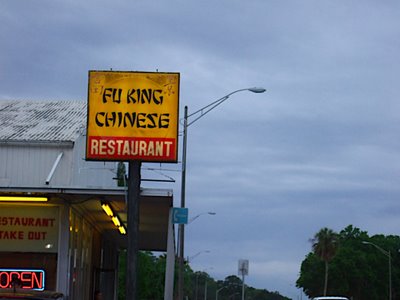
Actual sign located on Hwy 41.
And, no, this isn't the problem with the economy; the answer isn't quite that easy.
3/11/08 Jim Cramer from CNBC:
"Bear Stearns is not in trouble."
<Cramer's funny. Bear Stearns went under six days later.>
6/5/08 CNBC Reporter:
"Cannot compare Bear and Lehman. Lehman management is incredibly engaged and responsive."
<Lehman Brothers went belly up about three months later.>
10/4/07 Jim Cramer of CNBC:
"Bank of America is now the cheapest and the best. I have to admit, as much as I like Wachovia, Bank of America is going to $60 in a heartbeat."
<Are you kidding me?? Cramer is financial pornography.>
2/1/08 Jim Cramer, again:
That's why the market will not quit, no matter how poorly companies are actually doing."
<Wait for it: The Dow was at 12,743.>
4/16/08 Larry Kudlow of CNBC:
"The worst of this sub-prime mess is over."
<Yes, the Dow was still over 12,000... 12,619. Glad it didn't go any lower. Oh, wait, it did.>
6/13/08 Jim Cramer, yet again:
"Very simply, I believe that it means it's time to buy, buy, buy!"
<The Dow was at 12,307. Jimmy! Tsk! How could you say that?!?!>
November 2008 Fast Money on CNBC:
"People are starting to get their conficence back."
<Hah! The Dow was at 9,625!!!>
Okay, it's easy to point fingers, but how could so many people be so horribly wrong? Ask anyone around me, and they'll tell you I've been pessimistic about the short-term economy since late 2005 / early 2006. Just like the craze over tulips decades ago, bubbles build up and pop. We have economic cycles, too. Rarely does a bubble inflate at the top of an economic cycle and prolong it until the downcurve resembles a cliff more than a gentle slope. But rarely happens, and it happens too frequently to bet real money on it when it's your life savings.
Consider the Martingale system of making a quick hundred bucks. Learn the odds of Blackjack and when to ask to be hit and when to hold. You'll end up with something very close to a fifty-fifty chance.
Now go into a casino and bet your hundred bucks. If you lose, you "double down" and bet $200. Win and leave. Or lose and double down again with $400. If you don't win, you double again... to $800. (Any time you hit the house limit or get told no more doubling, go next door to another casino.) Win and leave or lose and double to $800. Win and leave or lose and double to $1,600. Win and leave or lose and double to $3,200. Win and leave or lose and double to $6,400. Win and leave or lose and double to $12,800. Win and leave or lose and double to $25,600. Win and leave or lose and double to $51,200. Win and leave or lose. Let's stop here and evaluate.
If you've lost so far, how much have you lost?
100 + 200 + 400 + 800 + 1,600 + 3,200 + 6,400 + 12,800 + 25,600 + 51,200 = 102,300.
It only took ten times in a row for the odds to go against you sufficient to cost your greedy self over a hundred grand. All you wanted was $100. Most days, you'd have gotten it. The economy, and therefore the stock market, is similar. You can stretch even the best rubber band only so far before it breaks. Most decades, you could buy good stock and hold it for a profit. Most decades, you could do well in your average good mutual fund portfolio. Recently, you could lose your butt.
However, you can't get rich shorting an overheated <and doomed> market, either. Sometimes the market can remain irrational longer than an investor can remain solvent.
<Introducing, with an old saying, one of my very favorite sayings of all time:xx>
"The early bird gets the worm, but the second mouse gets the cheese."
I have a very very good friend who, besides being a genius, could see the market was going to crash. Using options as a strategic investment, he constructed a nice series of puts and calls designed to double or triple his wealth when the market broke and went south. First mouse. Those steel spring-loaded mousetraps hurt.
We'll come back to the quotes later. I ran across some real doozies from the 1930's. We'll also cover why I like to get Glenn Beck's take on the economy occasionally. (It isn't what you think.) Meanwhile, how can you be the "second mouse"? <important stuff coming>
As I write this, April 6, 2009, the Dow has just had a little flurry upward that some folks think is a rally. Rally??? Really??? Is the recession over??? NO! NO WAY!! The depression is just getting wound up nice and tight. We have major banks on the brink of failure. As we come into Summer, I fully expect Bank United, Florida's largest bank to fail. I can't see how Countrywide could survive, and any entity stupid enough to purchase Countrywide (Bank of America) doesn't have much better chance of survival than a snowball on a Texas sidewalk in July. Bank of America is in trouble, and its failure wouldn't surprise me a bit. That 3-ton gorilla over in the corner (Citibank) doesn't look too healthy either. Can the FDIC manage a Citibank bailout?
The problem is the REOs. (That's Real Estate Owned by financial institutions for my friends in Pasco County.) The financial geniuses that loaned all that money for all those houses have already gotten some of them back. The real "stinkers", some of them, haven't been sold yet. When they sell, like one house in our neighborhood I can point to as an example, the loss will be what accountants call "realized". I like that term because it's a double entendre in this case. The house I can point to was hocked to Countrywide Financial and foreclosed on for a whopping $177,000 and change. It's been on auction, on one-week auctions, for over a month, with a minimum bid of $37,900. It hasn't sold. When it sells, if it sells for $37,900, Countrywide will realize its loss—$140,000. This is why the REOs are such a problem—the realization is coming.
Picture the news reports about large bank failure after large bank failure. Picture the Dow plunging to something between $3,000 and $5,000. Picture all this happening between the activity of tornado alley in the late Spring and the beginning rumbles of hurricane season. Imagine newscasters broadcasting despair, investors jumping from windows, and elderly, retired people lamenting the demise of their nesteggs. Got that picture clearly in your mind? Focus on that image and then listen to the words of Warren Buffett, "If you wait until you hear the robins singing, Spring is over." When all those around are in despair, when the news reports are replete with doom and gloom, that's the time to buy. Buy good companies like Kraft Foods, General Electric, Coca-Cola, etc. The early bird gets the worm, but the second mouse gets the cheese.